Exhibition Review – Ireland Roundup, Art Monthly, Issue 476, May 2024.
Aleana Egan: Second Hand Lismore Castle Arts Waterford 23 March to 19 May
Eilis O’Connell: In the Roundness of Being VISUAL Carlow 17 February to 12 May
In St Carthage Hall – a former Victorian chapel refurbished as an offsite exhibition space for Lismore Castle Arts – Aleana Egan’s enigmatic installation, ‘Second-hand’, feels like a half-remembered dream. The otherwise sparse, rectangular hall is architecturally softened by arched windows and the curve of a dark-beamed roof from which a curiously textured canopy is suspended. Thin strips of fabric have been affixed to this floating structure, and stray pieces gather on the mesh platform below.
Such a skyward arrangement in this setting feels at once apparitional but also strangely familiar. My mind wanders to the ornate canopies of medieval churches that would historically enshroud altars and enhance their prominence as sites of divinity and worship. Decorated with ornamental tassels or lanterns, these inverted platforms often hold curtains that are drawn during parts of the liturgy to form a kind of sacred tent. Titled a moment of return, 2024, this work also calls to mind the ancient but enduring custom of tying ribbons or strips of cloth to the branches of hawthorn trees beside holy wells (known as clootie wells in Scotland, where this practice also continues). Part of a pagan ritual, ailments are said to heal as the fabric on rag trees disintegrates over time.
Egan’s assorted cloth strips appear to have been dyed to match the colour palette of the hall’s stained-glass windows, which in turn resonate with the natural pigments of medieval Celtic manuscripts. Visible above the rags is a glistening layer of magnetic cassette tape, which has obvious associations with recording and transmission. Relevant here too is the history of Lismore, a once-renowned seat of learning in monastic Europe which straddled the shift from oral culture in Ireland to the writing of ecclesiastical annals. If the ‘moment of return’ relates to language and its resurrection, then ‘second-hand’ may denote information that is indirectly overheard or covertly obtained.
The installation’s second element is build the air, 2024, which takes the form of a women’s dressing table, painted red and containing several boudoir items that I read as pointedly gendered, proxy liturgical objects. The trifold vanity mirror easily channels the triptych format of the Middle Ages – devised to aid prayer and the relaying of biblical stories – now remade as one of personal devotion to one’s appearance. Beads hang from the mirror, floral fabric is draped on the stool, perhaps understood as some kind of vestment, while a small, round, crystalline container, filled with tiny metallic discs, replicates almost exactly the lidded vessel or pyx that contains the host during the celebration of Eucharist in the Catholic church.
The ‘holiness’ of this dresser-as-altar is further emphasised through symmetry. Two wall-mounted sculptures – long, narrow bands of folded card, tightly bound with tape – are situated on either side, as if demarking this devotional space. Ordinarily foregrounding the scale and proximity of the body, the staged furniture, codified artefacts and clothing only serve to reinforce bodily absence in this instance – not least, former congregations. As I turn to leave, a shaft of sunlight falls softly onto the floor, casting a colourful spectrum and infusing this hallucinatory realm with an energetic hum.
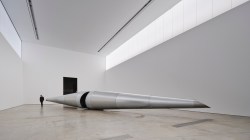
At over 21-metres in length, Eilis O’Connell’s new commission for VISUAL is quite possibly the largest sculpture I have ever encountered in a gallery in Ireland. Capsule for Destinies Unknown – series two, 2024, diagonally bisects the hangar-like Main Gallery and is the centrepiece of the pristine exhibition, ‘In the Roundness of Being’, which explores coexisting strands of O’Connell’s sculptural practice across domestic and monumental scales.
Over the past five decades, O’Connell has amassed a vast sculptural vocabulary of organic and geometric forms. As well as maintaining a studio-based practice, O’Connell has previously created towering sculptures for the public realm. Her artworks are formally abstract but habitually contain traces of figuration, including the artist’s own imprint and mark-making. In the Link Gallery, a dozen small-scale works in bronze, limestone and marble are presented on spot-lit plinths – a museological display that would equally suit an assortment of natural history objects: rocks, shells, fossils, bones.
This poised approach continues in the Studio Gallery. The tall, slender, dual forms of Leaning, 2022, suggest prehistoric tools: spears, chisels, gouges, sickles. This proximity to everyday objects – whether natural or manmade, ancient or modern – attests to a pervasive ambiguity of form. We learn from an accompanying video that the artist is interested in archaeological artefacts and is drawn to the longevity of metal, particularly bronze.
Close looking gives way to dazzling natural light and the engulfing scale of the soaring Main Gallery. The epic Capsule for Destinies Unknown – series two is an elongated and perfectly balanced form that comprises two conical ends and a central chamber. I find myself repeatedly encircling it before entering the doorway into what feels like a flight deck. The work has origins in a similar piece made in 2017 for ‘ARK’, a major exhibition of contemporary sculpture in Chester Cathedral. Responding to themes of physical shelter and refuge in the context of the then burgeoning European migrant crisis, O’Connell utilised corrugated galvanised steel, polycarbonate sheeting and other materials commonly used to make temporary living spaces.
However, where the 2017 sculpture echoes the anatomy of marine life, boats, submarines or torpedoes, this new commission in Carlow feels more precisely of the sky. It is an aerodynamic yet flightless form, a grounded aircraft of unknown origin. Fabricated in steel and Perspex with a heavily riveted surface, it resembles a warplane, harpoon missile or sniper scope, and is bleakly understood against the prevailing backdrop of escalating militarisation across the western world. While Ireland does not have a history of arms manufacturing, the country’s longstanding neutrality is unequivocally compromised in allowing US military stopovers in Shannon Airport – an occurrence met with unceasing protests since the Iraq War that have intensified amid the horrors unfolding in Gaza. The only other artwork in the Main Gallery is the shadowy, black, wall-based sculpture In the Roundness of Being, 1996, from which the exhibition takes its title. Like a dark, distant silhouette, this comparatively tiny form returns us once again to the proportions of the body and, in this dramatic adjustment of scale, we are hauntingly reminded of our own fragile corporeality in the face of tectonic geopolitical pressures.
Joanne Laws is an arts writer and editor based in the west of Ireland.
Featured Image: Eilis O’Connell, ‘In the Roundness of Being’, installation view, VISUAL Carlow; photographs by Ros Kavanagh, courtesy of the artist and VISUAL Carlow
 Joanne Laws