Essay – ‘From the Periphery to the Centre’, Cornelius Browne at Regional Cultural Centre, February 2023.
“I hope that my readings of particular terrains, although naturally couched in terms of human scales, those of my own limbs, eyes, breath etc., are suffused by an awareness of almost inconceivably greater and unimaginably smaller physical dimensions, not to mention those of the flowery fields and terrible cliffs of dreams.” – Tim Robinsoni
Over the course of five decades, writer and cartographer Tim Robinson (1935-2020) mapped with precision, attention and lyricism, the landscapes of Connemara, The Burren and the Aran Islands. Robinson referred to this deep mapping practice as ‘Geophany’, which he defined as the “sudden showing forth of the nature of a landscape” or a “brief epiphany of place.”ii Robinson’s durational fidelity to the west of Ireland landscape comes to mind when considering the plein air painting practice of Donegal-based artist, Cornelius Browne, since the cartographer and the landscape painter share many affinities and motivations.
Both chronicle – through exposure to the elements – the shifting landscape across the gradual arc of the seasons, and each are tasked with transcribing this encounter into some tangible form. Just as Robinson preferred the slow pace of a land traversed on foot, Browne largely paints within walking distance of his house, rendering his immediate landscape a microcosm, inscribed with the patterns of a body in motion. Like all pilgrims in search of divinity, they are rooted in contemplations of scale, from the vastness of the cosmos to the tiny segments of earth they inhabit. In considering human connection and what it means to dwell, the painter and the cartographer often convene with ancestors who have inhabited this terrain since prehistoric times. Yet despite the seemingly fixed nature of rock and stone, landscape is an elusive force that perpetually transcends our knowledge of it.
On the occasion of Browne’s much anticipated solo exhibition, ‘All Nature Has a Feeling’ at the Regional Cultural Centre in Letterkenny (18 February – 25 March 2023), it seems fitting to reflect on this new body of work using spatial terms, such as inside and outside, periphery and centre. Patently, Browne’s artistic practice is almost entirely devoted to the exterior realm, since the discipline of plein air painting historically released artists from the confines of the studio, through innovations in portable easels and paint tubes. In addition, Browne lives and works in the rural hinterlands of west Donegal – a remote territory far beyond the metropolitan centre, at theouter edge of this island, on the periphery of Europe. While physical dislocation need not always be a barrier to participation, the artist also existentially positions himself at a remove from the art world – a term already fraught with notions of dispersal – in a purposeful withdrawal that began in art college and lasted for twenty years. While Browne pursued other creative endeavours during this time, he has only returned to painting in the last decade. In a further avowal of artistic retreat, Browne has cultivated a simple life of absorption in art, music, literature, poetry, and film that relinquishes the material obsessions of mainstream consumerist society.
Browne counts among his creative idols, outsider artists such as fisherman Alfred Wallis (1855-1942) who began painting in his seventies, using boat paint on cardboard salvaged from the local grocer; Canadian folk artist Maud Lewis (1903-1970) who exemplified the simple life in a remote maritime province in Nova Scotia; and Joan Eardley (1921- 1963) known for her tender studies of Glasgow street children and her expressive depictions of the tiny Scottish fishing village where she lived. Interestingly, what further connects these three artists is their strong associations with nautical painting – something that equally resonates with Donegal’s north-west Atlantic coast, historically an enclave of ‘primitive art’ due to the legacy of the Tory Island Painters. Using their wild surroundings as dramatic subject matter, this small group of plein air painters was led by Derek Hill (1916-2000) who built a painting hut on the island and inspired local fisherman to paint. A key figure was James Dixon (1887-1970) whose artistic legacy includes a two-person exhibition with Wallis at IMMA in 1999. Prophetically, Hill gifted Browne his first set of oil paints in the early-80s.
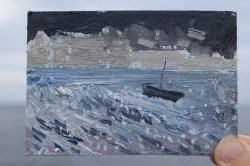
Artworks selected for Browne’s exhibition at RCC are configured in site-specific clusters, presenting multiple depictions of the local landscape at different times of the year. This methodology hinges on the artist’s daily ritual of painting outdoors, often working at speed on small boards to capture fleeting moments in all weather conditions. Like logbook entries, the resulting artworks chart a fluctuating landscape that has been cast into the current of time. A boat hurtles through a blizzard at dusk, encircled by a vortex of golden snowflakes. There are atmospheric studies of the midsummer moon, and turbulent seas at daybreak. On occasion, the vertical drag of a brush causes wet paint to bleed convincingly into the sea, as an impending downpour might engulf the dark horizon.
Very few paintings contain human figures; instead, traces of habitation are found in distant houses, grazing animals, or bright vessels moored along the shoreline. Trees are adorned with jewel-like flurries of autumnal leaves, colourful kites trail across blustery skies, while magenta flecks in the hedgerows usher the blossoming days of spring. Surfaces are stippled with surprising marks, as luminous as celestial particles that coalesce and dissolve in front of our eyes. All the while, raindrops accumulate on the canvas like blisters, repelled by the oily veneer of thick, fresh paint. As the world continues to shrink, becoming increasingly ‘knowable’ through technology, there is profound diligence in scrutinising a place, yet perpetually seeing it afresh. In making legible the enduring beauty and sanctity of remote Donegal, Browne’s work must therefore be conceptualised, not on the periphery or outer edge, but at the frontier and epicentre.
Joanne Laws is an art writer and editor based in County Leitrim.
Featured Image: Cornelius Browne, Sea Interlude: Black Boat, 2022, oil on board; photograph by Paula Corcoran, courtesy of the artist.
i Pippa Marland, ‘Adequacy is for archangels: an interview with Tim Robinson’, Land Lines, May 2014, landlinesproject.wordpress.com
ii Tim Robinson, My Time in Space (Dublin: The Lilliput Press, 2001)
 Joanne Laws