Catalogue Text – ‘An Inherent Dualism’, Joanna Kidney at The LAB Gallery, Dublin, November 2022.
Since the Renaissance, no other painting technique has been subject to such zealous and detailed attempts to explain its methods, materials, and utensils as the encaustic technique of antiquity [i]
Deriving from the Greek term enkaustikos, meaning ‘to burn’, encaustic painting is a classical technique in which dry pigments are mixed with molten beeswax and a small portion of damar resin, to increase melting temperatures. Perhaps the most famous and well-preserved encaustic works are the Fayum Portraits, painted by Greek settlers in the Fayum region of Egypt in the first and second centuries A.D. These funeral portraits formed part of the customary religious ritual; they were placed on mummified bodies, later excavated by British archaeologists in 1887.
The almost forgotten encaustic medium was periodically revived and revolutionised by experimental artists throughout the twentieth century, from Jackson Pollock’s works on paper in the late-1940s, and Jasper Johns’s iconic American flag paintings of the 1950s, to Lynda Benglis’s organic and highly textured paintings in the 1960s. Indeed, Mexican muralist Diego Rivera considered encaustic to be “the most solid of the painting processes…except for fired enamel.”[ii]
Using a temperature-controlled palette, the pigmented beeswax is melted and applied to a porous, rigid support; the hotter the molten paint, the faster it glides during application.A heat torch is passed across each layer to ‘burn in’, thus fusing and bonding the surface. Like the firing of ceramic glazes in kilns, the alchemical transformations of wax, fire, and pigment can cause surfaces to bubble and shift. Once cooled and hardened, the mercurial surface can be scraped, marked, incised, and otherwise expanded or subtracted. It is encaustic’s malleability and its proximity to drawing that appeals to Irish artist, Joanna Kidney, who has pursued a continually evolving vocabulary of drawing for over two decades.
Using drawing as a tool for thinking, translation, and discovery, she deploys the values of her artistic practice, which include curiosity, elasticity, and the handmade. Several previous experimental projects have focused on automatic drawing, as well as collaboration and co-authorship, through which the artist can relinquish control, while discovering new marks, shapes, and lines – lexicons which are constant in her work. Since 2006, the artist has experimented with the technically demanding processes of encaustic painting, motivated by the qualities it shares with drawing, specifically its immediacy, intimacy, and potential for subtraction. Harnessing this versatile but unpredictable medium has allowed the artist to merge the primitive language of drawing with the complex, archaeological language of painting.
The artist’s current solo exhibition, ‘The Swinging Pendulum’ at The LAB, presents a new body of encaustic paintings and an experimental, participatory project. The exhibition title broadly draws on concepts of extremity and opposition, while also referencing the specific polarities and tensions arising from the encaustic medium itself. This includes an inherent dualism manifesting across encaustic’s material states (hot and cold, liquid and solid, opaque and translucent); its processes (planning and improvisation, accumulation and subtraction, order and chaos); its visual language (light and dark, smooth and textured, sharp and undefined); and the medium’s temporality (encompassing speed and slowness, permanence and flux, contemporaneity and antiquity).
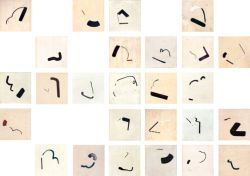
The conceptual core of the exhibition is The Transmitter, an installation of approximately 140 encaustic paintings on panels, made over the last three years. Loosely configured in rectangular formation on the gallery wall, the composition is punctuated with occasional gaps, while panels also extend beyond the imposed order of the grid. At first glance, the collective works appear almost monochromatic and minimalist; however, on closer inspection, the binaries of dark and light give way to a more nuanced palette. In some instances, the woodgrain of the plywood support has penetrated the honey-coloured ground. Elsewhere, specs of colourful pigment seep through the porous membrane, while small flecks of waxy residue, blisters, lumpen areas, and other imperfections can be found upon the smooth surfaces. These elements create texture, while serving to evoke a human quality.
Another series of larger, lighter, and more colourful paintings, makes visible the layers of history involved in their creation, which imbue each panel with a sense of compression and depth. Fabricated on an even larger scale (up to one metre square) a third series of predominantly dark paintings attests to the artist’s studies in colour theory. Constructing these paintings with distinct layers, she started with a yellow ground and moved through the spectrum, making decisions about translucency, opacity, and saturation. For these darker paintings, she worked with a reduced colour palette, comprising primary colours, white, and burnt umber.
In highlighting the transformative nature of encaustic, its unique tactility, luminosity and physicality, the artist also seeks to make visible the medium’s methodical and meditative processes, which necessitate the distillation of artworks over long periods of time. For this exhibition, slowness also extends to the viewing process, through the inclusion of a darkened space with seating for contemplation and ‘slow looking’ – a gesture described by the artist as an “antidote to a world of fast imagery and words”.
The artist’s adherence to seriality – evident across all three bodies of paintings – also points to formal considerations such as composition. One wonders about the structural decisions, made during the painting process, that have allowed some elements to remain, while others have been lost or recovered, obscured or scraped away. A strong sense of kinesthesia permeates these arrangements, with rhythmic patterns often recalling dance steps, choreographic diagrams, or traces of absent bodies. In fact, many of these compositions were informed by a series of experimental drawings, titled ‘#themovabledrawingsproject’, in which the artist placed found objects and pieces of driftwood in loose configurations on various backgrounds, including the floor. These temporary arrangements were variously photographed, sketched, and examined through viewfinders to make detailed studies. The objects were also utilised directly on the paintings, allowing the artist to sketch out provisional compositions.
This experimental methodology also feels like a natural extension of the artist’s work as an educator, which in this instance translates perfectly into a public engagement project for the gallery context. The artist has opened out ‘#themovabledrawingsproject’ as an invitation for others to playfully explore the possibilities of drawing. Situated in the upper gallery is an informative video, which introduces and contextualises the project, the artist’s thoughts on drawing, and its role in her practice. The video is presented alongside a table of viewfinders and tactile materials, such as felt, thread, and found objects, encouraging gallery visitors to make their own temporary, three-dimensional drawings.
Returning to the history of wax, it seems fitting to recall its functionality as an excellent preservative of materials, which in turn points to deeply held associations with antiquity, nostalgia, reverence, and spirituality. Wax seems to hold the memory of things embedded in its layers, like natural elements fossilised in amber. From the most translucent glaze to the thickest impasto, encaustic’s richly textured and fleshy qualities bring it into close proximity with the human body. Indeed, some have commented on the metaphorical attributes of wax as a “primordial, skin-like substance” which evokes “bodily sensations, emotion, layers of history, religious rituals, and the passage of time”.[iii] A kind of chaos seems central to this sweet-smelling, unwieldy, introspective medium. In its associations with primitivism, preservation, and memorialisation, encaustic offers a perfect analogy for the transience of nature, humanity’s attempt to impose order, and the underlying entropic nature of all things.
Joanne Laws is an art writer and editor based in the west of Ireland.
Featured Image: Joanna Kidney, The Transmitter, 2019-22, installation, encaustic on panel; image courtesy of the artist and The LAB Gallery.
[i] Kurt Wehlte, The Materials and Techniques of Painting (New York: Van Nostrand Reinhold Company, 1982) p 555.
[ii] Diego Rivera, quoted in Bertram D Wolfe, The Fabulous Life of Diego Rivera (New York: Stein and Day Publishers, 1963) p138. See also Lucy Pearse, ‘Diego Rivera’s Use of a Wax Medium in the 1920s’, WAAC Newsletter, Volume 16, Number 1, January 1994, pp 17-20.
[iii] Edward M. Gomez, ‘ART / ARCHITECTURE; Improvised Images in Molten Wax, as Fluid as Jazz’, New York Times, 16 May 1999.
 Joanne Laws